Mini Excavator Price from China: 1 Ton, 2 Ton, 3.5 Ton and 8 Ton — 9 Checks Before You Pay
- ✓Start from the job, then pick the tonnage
- ✓Four specifications set the price — not the brand
- ✓The engine: genuine Yanmar or Kubota, a Chinese industrial diesel, or an air-cooled single-cylinder
Last week a contractor in Kalimantan sent me three quotations for a 2-ton class mini excavator. All three were marketed as "2 ton, diesel engine, 12-month warranty", at $8,400, $11,900 and $14,300. Only when I asked for photos of the engine nameplate and the hydraulic pump did the difference show up: the $8,400 unit was a 1.5-ton class machine with an air-cooled single-cylinder engine and a gear pump, sold as a 2-ton; the $14,300 machine — quoted slightly above my usual band for the class because the engine is genuine — had a three-cylinder Yanmar in the 3TNV70 class and a variable piston pump with pilot joysticks; the one in the middle had a Chinese three-cylinder engine with a gear pump: mid-price, but the weakest hydraulics of the three.
Cheap is not automatically bad, and expensive is not automatically right for your job. The real problem is that mini excavator quotations in the Chinese market rarely state the numbers that actually decide the price: operating weight, engine power in kW, bucket capacity in m³, maximum digging depth, and the brand of the hydraulic pump. For the past four years I have walked factories in Zhengzhou, Jining and Quanzhou with buyers from Indonesia, Malaysia and Nigeria. The nine points below are the order I use every time I pick a mini excavator — you can copy the whole sequence even if you buy directly, without an agent.
Run the numbers yourself with the calculator →
Compare 1 t / 2 t / 3.5 t and HZS50 / 75 / 90 in one table →
1. Start from the job, then pick the tonnage
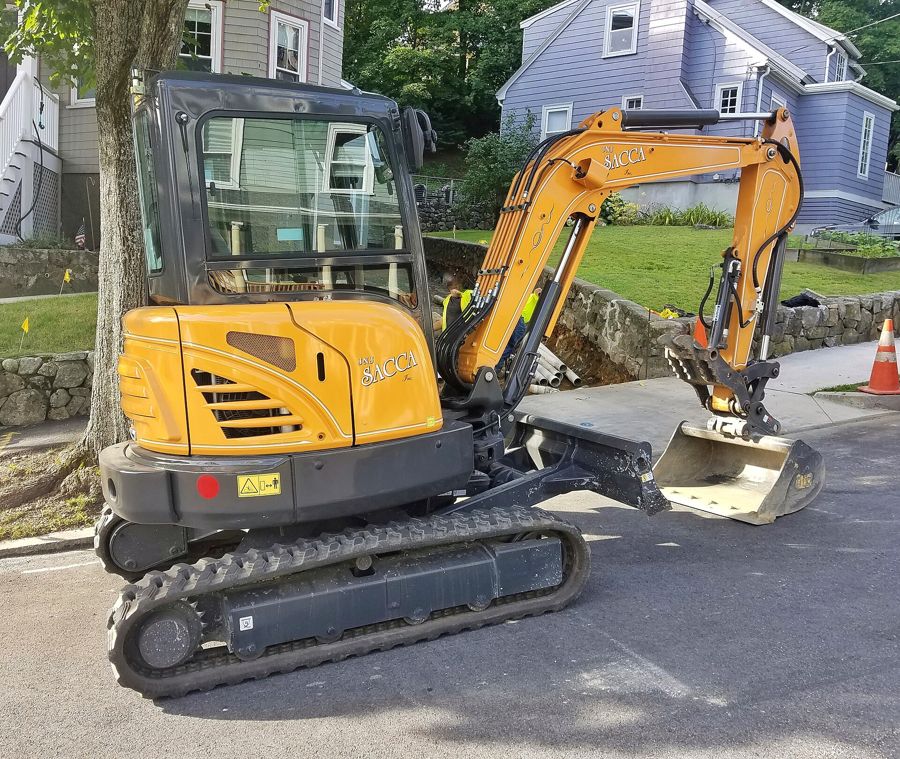
Write down the work you do most often: a 0.8–1.2 m pipe trench, house foundations, land clearing on a farm, or loading at a small quarry. The 1-ton class suits narrow trenches and yards because those machines are 0.95–1.05 m wide; the 1.5-ton class is about 1.0–1.3 m wide depending on the track setting. The 2.5–3.5 ton class is a favourite with house builders: it can dig foundations and still get down a village lane. The 5–8 ton class only makes sense if you genuinely have the daily soil volume or truck-loading work to keep it busy. I have watched buyers pay 40 percent more because a salesman pushed a bigger class. I have also watched a buyer put a 1-ton machine on what is really 3.5-ton work, so the machine ran at its limit every day and failed within a year.
2. Four specifications set the price — not the brand
Every time I compare quotations, I force every seller to write four numbers on the same page: operating weight (kg), engine power (kW), bucket capacity (m³) and maximum digging depth (mm). The 1-ton class is usually 1,000–1,200 kg with a 0.03 m³ bucket; the 2-ton class around 1,900–2,100 kg with a 0.06–0.08 m³ bucket; the 3.5-ton class around 3,300–3,800 kg with a 0.11–0.14 m³ bucket; the 8-ton class around 7,500–8,200 kg with a 0.25–0.30 m³ bucket. If a quotation says "2 ton" but the operating weight is 1,400 kg, you are being offered a 1.5-ton machine wearing a 2-ton badge. That happens often, and it is not always a scam — sometimes the seller does not know his own product. If the seller never states an operating weight, use this rule of thumb: a "2 ton" quotation below 1,900 kg is really a 1.5–1.8 ton machine — price that against the band below it (the safe rule for a buyer), not against the 1.8–2 ton band — and a "3.5 ton" quotation below 3,300 kg is really a 2.5–3 ton machine. Get the operating weight in writing for every class you compare, because that number sets the price, not the label in the quotation title.
3. The engine: genuine Yanmar or Kubota, a Chinese industrial diesel, or an air-cooled single-cylinder
For the 1–3.5 ton class the Chinese market uses three engine families. First, genuine imported engines in the Yanmar 3TNV70 / 4TNV88 or Kubota D1105 / D1703 class — the most expensive, the easiest to get parts for, and the quietest. Second, Chinese industrial diesels such as Xinchai, Laidong, Changchai or Yunnei — some $800–1,500 cheaper than the imported-engine class, with parts readily available, but with assembly quality and tolerances that vary from factory to factory. Third, air-cooled single-cylinder engines — the lowest-cost option, and not designed for eight hours of continuous work. Ask for a photo of the engine nameplate and serial number, then match it against the brochure. A serious factory sends that photo without arguing; the ones that refuse usually have a reason.
4. Hydraulics: gear pump or a pilot-controlled piston pump
This is the part most often quietly downgraded. A 1–1.5 ton machine with a gear pump and mechanical lever controls is normal for that class. But from the 1.8–2 ton class upward, a machine meant for daily production should have a variable piston pump with pilot joysticks, because oil flow then follows the load and the machine does not cook its hydraulic oil. Ask for the pump brand (Kawasaki, KYB/Nabtesco or Parker class, or a named Chinese brand such as Hengli), the flow in litres per minute, and the working pressure in bar. Also ask whether there is a separate hydraulic oil cooler. If the salesperson cannot quote a single flow figure, he does not know the machine well enough to sell it to you.
5. Undercarriage and tracks: the first thing to wear out
The undercarriage is most of your long-term maintenance bill. In the 1–3.5 ton class, rubber tracks are gentler on roads and concrete yards but are cut and punctured more easily on sharp rock; steel tracks last longer in quarries and on farms. Ask for the number of bottom rollers, the number of track links and the track brand. On a used machine, measure bushing wear and check idler alignment. One practical test: ask the operator to lift one side on a block and turn the track slowly — if the chain jumps or the sound is rough, you are looking at a new track set — roughly $200–400 for rubber tracks on a 1–1.5 ton machine and $600–1,500 for steel chains and shoes on a 3.5 ton machine, which most buyers forget to budget for.
6. Cylinders, hoses and pins: look for fresh welds and weeps
Get under the machine and look at the chrome rods. Scored chrome, blue heat marks, or a fresh weld on the cylinder ear means the machine has worked hard or has already been repaired. Check the hydraulic hoses too: branded hose in the Parker or Manuli class lasts longer under heat than unbranded generic hose. Grab the pins and bushings at the boom, arm and bucket joints and shake them — play you can feel by hand usually means a re-bushing job, around $150–400 if a local workshop does it. All of this can be photographed and sent to you in ten minutes, if your agent is actually standing in front of the machine.
7. Canopy or cabin, air conditioning, and whether you can get parts
A canopy is $700–1,500 cheaper than an enclosed cabin. For the climate in Indonesia, Malaysia or Nigeria, a sealed cabin with air conditioning is far more comfortable and keeps dust off the operator, but remember that A/C puts extra load on the engine and needs servicing. What buyers forget is parts availability at home. Ask about the oil filter, fuel filter, cylinder seal kit and rubber tracks — can they be bought locally or must they be imported? A good factory sends part numbers so you can check. Also ask for photos of the specific machine that will be shipped, not the catalogue photo used for every buyer.
8. Test the machine before you pay: 45 minutes that save thousands
Before the balance payment, ask for test video, or better still, send someone to run the machine. What I check: cold start, exhaust smoke and blow-by from the breather, engine and hydraulic oil colour, boom-arm-bucket cycle time, swing play and slew ring noise, straight travel in both directions, and a 15-minute dig in real ground, at working depth. Then match the hour meter against actual wear: a 900-hour machine should still have tight bucket pins and tracks with life left. Slack pins or thin links at that reading mean the machine has done hard breaker work or rock work, or that the hour meter has been wound back — so ask for the service record before you trust the number. If you cannot fly to China, this is exactly what two services are for: the $50 Live Visit factory video call and the $100 12-point inspection before the balance payment. They are not a sales pitch — they put a person in front of the machine who reports what is actually there. For the balance, also get the warranty scope in writing in the contract: how many months, which components are covered, who pays the freight on replacement parts and who does the work in your country. Ask for a one-year spare parts kit price at the same time — oil and fuel filters, cylinder seal kit, hoses and one track set — so the machine is not sitting idle for months waiting on imported parts.
9. Cost it to your site: import duty, VAT and customs clearance
The FOB price is only part of the story. Mini excavators enter most markets under HS 8429.52. Import duty depends on your import scheme — 0 percent under some facilities, 0–5 percent on ordinary imports — and then VAT and withholding tax apply, plus the customs clearance agent's fee, port charges and trucking to your site. Container planning matters too: the 1–1.5 ton class usually goes two per 20-foot container; a 1.8–2 ton machine is generally one per 20-foot (two per 40-foot high cube); a 3.5 ton machine is one per 20-foot with the canopy removed and the boom folded; and 5–8 ton machines need a 40-foot high cube or a flat rack. Never use a duty rate from a blog or a forum without checking it with your own customs broker against the actual proforma invoice, because rates and exemptions differ by importer and by commodity. Before you transfer anything, ask for a proforma invoice that states the deposit percentage, the balance trigger (for example, after the inspection passes) and the beneficiary account name. Match the account name against the company name in the contract — never wire to a personal account, even if the request comes from the same salesperson.
Mini excavator price from China: the pricing rule we use on every inquiry
Reference FOB figures at Chinese ports for 2026, from the quotations we collect: 1–1.5 ton class $6,800–9,500 per unit; 1.8–2 ton class $9,800–13,500; 2.5–3.5 ton class $14,500–21,000; 5–6 ton class $23,000–32,000; 8 ton class $35,000–48,000. Those prices normally include one standard bucket, a tool kit and a manual; they exclude extra attachments, spare parts kits, bank transfer and exchange-rate costs, freight, import duty and destination taxes. Our rule is simple: every inquiry must produce at least three written quotations from different factories, compared on the same four specifications, plus one quotation for an imported-engine equivalent as a price benchmark. We never claim the lowest price, because your final cost is set by specification, distance from the factory to the port and the exchange rate — not by a salesman's promise.
Frequently asked questions
How much does a 1-ton mini excavator cost from China?
For 2026, the 1–1.5 ton class runs about $6,800–9,500 FOB per unit with one standard bucket. Machines with a genuine imported engine in the Yanmar or Kubota class sit at the top of that range; machines with an air-cooled single-cylinder engine sit at the bottom. Add roughly 20–35 percent for freight, import duty and taxes to your site, depending on your import scheme.
Does a mini excavator fit in a 20-foot container?
The 1–1.5 ton class usually loads two units per 20-foot container with the boom lowered; a 1.8–2 ton machine is generally one per 20-foot (two per 40-foot high cube). A 3.5 ton machine is one per 20-foot with the canopy removed and the boom folded; a breaker, if included, is strapped into the remaining space at the door end, not alongside the machine. From 5 tons up you normally need a 40-foot high cube or a flat rack. Always ask the factory for a loading plan drawing before you pay, so there is no cost surprise at the port.
What is the import duty on a mini excavator?
Mini excavators sit under HS 8429.52. The duty depends on your import scheme: some imports are charged 0–5 percent, and certain projects qualify for exemption facilities. After duty, VAT and withholding tax apply, plus the customs clearance agent's fee and port charges. Because rates and facilities differ by importer, this number must be checked by your own customs broker with the proforma invoice in hand — see the customs clearance section above.
Is the engine a genuine Yanmar or Kubota?
It depends on the model and the factory. Some factories fit genuine imported engines in the Yanmar 3TNV70 / 4TNV88 or Kubota D1105 / D1703 class; others use Chinese industrial diesels such as Xinchai, Laidong or Yunnei; the most basic class uses air-cooled single-cylinder engines. As the lowest-cost option, an air-cooled single-cylinder machine sits $800–2,500 below the imported-engine class depending on model and capacity, whereas the Chinese industrial diesel in section 3 runs about $800–1,500 below that class. Ask for a clear photo of the engine nameplate with the serial number, then verify that serial number with Yanmar, Kubota or their official distributor in your country. Rather than relying on an internal factory invoice, ask for a factory certificate showing the same engine make, model and serial number that appears in your contract and proforma invoice.
How long from order to arrival?
Production is 20–30 working days for standard models, 35–45 days with special attachments or custom colour. Sea freight from a Chinese port to Jakarta or Surabaya is usually 7–14 days, plus 3–7 days for documents and customs clearance. A realistic total is six to nine weeks from first transfer to a machine ready to work on your site, depending on the sailing schedule and your customs broker.
What if I cannot come to China to see the machine?
That is what the two services are for: a $50 Live Visit factory video call, where we stand on the factory floor and show you the machine that will actually be shipped, and a $100 12-point inspection before the balance payment covering the machine, hydraulics, undercarriage and documents. The written report, with photos and video, reaches your WhatsApp before you transfer the balance. We then match the inspection result against the four specifications written in the contract; if something does not match, we help you renegotiate with the factory. The cancellation conditions and their deadline are written into the service agreement and the proforma invoice from the start, so both sides know the rules before any money moves.