Mobile vs Stationary Water Stabilized Base Mixing Plant: Which One Fits Your Road Job?
- ✓What "Mobile" and "Stationary" Actually Mean
- ✓The Real Trade-Off: Mobility Costs You Structure
- ✓Match the Plant to the Contract, Not the Brochure
I have set up water-stabilized base plants on road jobs in China and across Southeast Asia for years — mobile units that fold up and move with the crew, and stationary plants bolted to a concrete foundation inside a workshop. Buyers ask me the same question every month: "Which one do I buy?" The honest answer is: it depends on three numbers — how many tons you must produce, how long the contract runs, and how many times the plant will move. Get those three right and either type can make money. Get them wrong and you will pay for the other type anyway, twice.
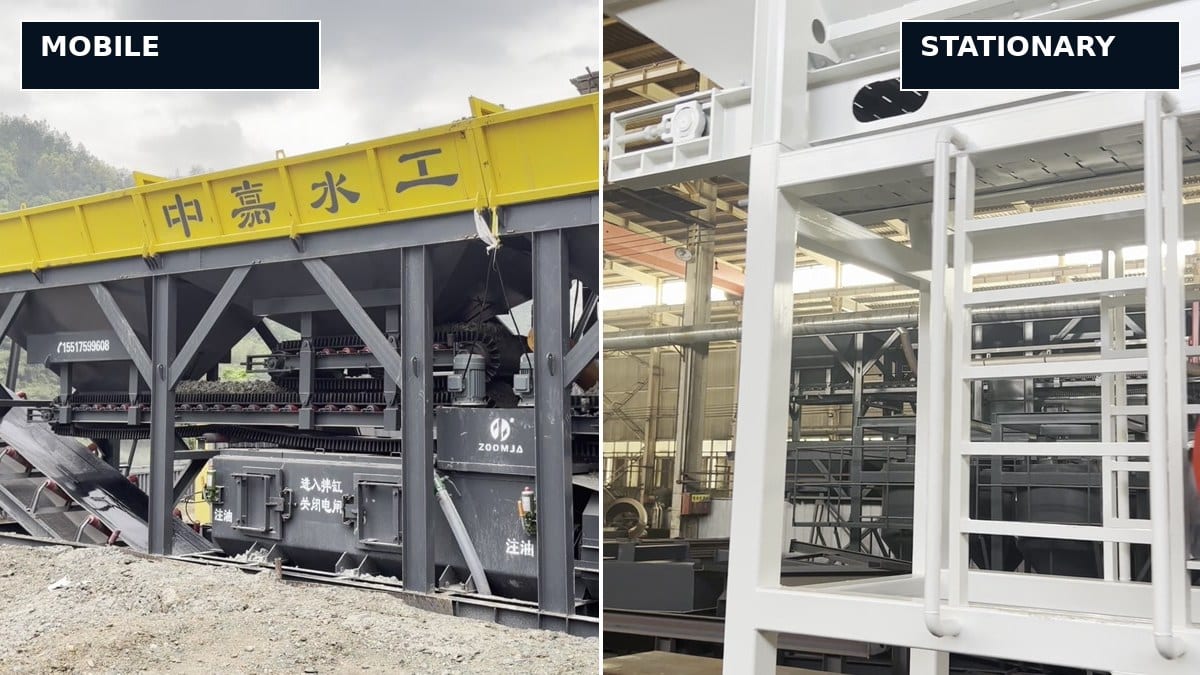
What "Mobile" and "Stationary" Actually Mean
A mobile water stabilized base mixing plant is a compact unit — bins, belts and twin-shaft mixer mounted on a chassis that folds for transport. A stationary water stabilized base mixing plant (also called a fixed or workshop-built plant) is designed to be installed once on a concrete foundation, with taller bins, longer belts and heavier structure. The same "500-type" label can hide either one. The name on the signboard does not tell you what is inside — the mixer does.
The Real Trade-Off: Mobility Costs You Structure
Nothing is free. To fold into road-legal transport, a mobile plant sacrifices bin height, belt length and structural weight. That means: smaller aggregate bins that need a loader feeding them more often, shorter belts that are steeper, and a lighter frame that flexes more under load. A stationary plant can run taller bins, longer belts and a heavier mixer — which is why two plants with the same mixer can still produce different real output. Compare the mixer, the belt scale and the water metering, not the paint.
Match the Plant to the Contract, Not the Brochure
I have watched buyers pay a 20% premium for a portable plant and run it on a two-year highway job where it never moved once. I have also watched buyers install a stationary plant for a three-month subgrade contract and then pay a full disassembly and re-installation cost to move it. The rule is simple: if you expect to move every few months, buy mobile. If the site is fixed or the contract runs more than a year, stationary almost always wins on cost per ton.
Output: The 70% Rule Applies Twice
Every plant's rated output assumes perfect conditions — dry aggregates, steady truck supply, no breakdowns. Real output is 70–80% of rated. A mobile plant has two extra penalties: smaller bins mean the loader cannot keep up on peak hours, and the shorter belt length reduces surge capacity. A 500-type mobile plant that delivers 300–350 t/h sustained is doing well. If your contract needs 400 t/h sustained for weeks, a stationary plant is not a preference — it is a requirement.
Moving Costs Are Real: Trucks, Cranes, Re-Foundation
Moving a mobile plant is not "free" — it takes 3–5 days of disassembly, 6–10 truckloads, a crane on both ends, and re-commissioning. Moving a stationary plant means cutting the foundation, lifting the mixer and silo, and pouring a new base at the next site — budget 2–3 weeks and 10–15% of the plant value per move. Count the moves before you count the price. A buyer who plans two moves over three years is often better off with a mobile unit even on a long contract.
Weighing and Metering: Where Stationary Plants Win
Cement is the most expensive ingredient in stabilized base, and water content decides whether the base compacts or fails the density test. Stationary plants usually carry a proper belt scale and metered water system with a visible flow meter. Mobile plants sometimes use a timer-based system that "guesses" the cement — and a 1% cement variance is the difference between a base that holds and one that cracks. Ask for the metering tolerance in writing, on both types, before you sign anything.
Site Conditions: Wind, Rain, and the Concrete Pad
A mobile plant is designed to be leveled on outriggers — fine on stable ground, risky on soft or sloping sites, and sensitive to wind when the bins are loaded. A stationary plant on a concrete pad shrugs off those conditions. In Southeast Asia's rainy season, the pad also keeps the loader and trucks from turning your yard into mud. If your site is compacted, dry and level, mobile is fine. If it is soft, wet or sloped, budget for a pad either way — or buy stationary.
Resale Value: Both Depreciate, Differently
Mobile water stabilized base mixing plants resell more easily because more buyers can use them. Stationary plants sell for less on the second-hand market but hold their value better if they are genuinely heavy-duty. The cheapest way to buy either type is to inspect the actual machine before you pay — video of it running, the nameplate, the mixer internals. A plant that was maintained is worth 60–70% after three years. One that was abused is scrap with a fresh coat of paint.
The Real Price Rule: Compare the Mixer, Not the Paint
A mobile plant may quote 10–20% lower than a stationary one of the same type — but the price gap narrows fast when you add re-foundation, re-commissioning and output loss. Compare three things on any quote: the mixer model and blade wear plates, the belt scale (real weighing vs timer), and the water metering system. A plant that holds spec for years is the cheap plant. The one that needs a new rotor in month six is the expensive one, whatever the invoice says.