How to Calculate Feed Pellet Machine Output Before You Buy
- ✓Size comes from ring die diameter and kW, not the model name
- ✓Output is a range, and the low end is the honest end
- ✓The compression ratio decides whether your material pellets at all
A poultry farmer in Central Java ordered a pellet mill quoted at 1.5 tonnes per hour. On his own material it ran at just under a tonne, and the mill was blamed for a month. The machine was fine. The number had been measured on a new die with dry corn, and his feed was neither.
When you buy a pellet mill, the tonnage is the last thing to trust first. The real capacity comes from the ring die diameter, the motor in kilowatts, the compression ratio of the die, and the moisture of what you feed it. Change any one of those and the output moves by 30 percent.
This guide gives the working numbers for each machine size, shows what actually moves the hourly output, and lists the questions you should ask before you pay a deposit.
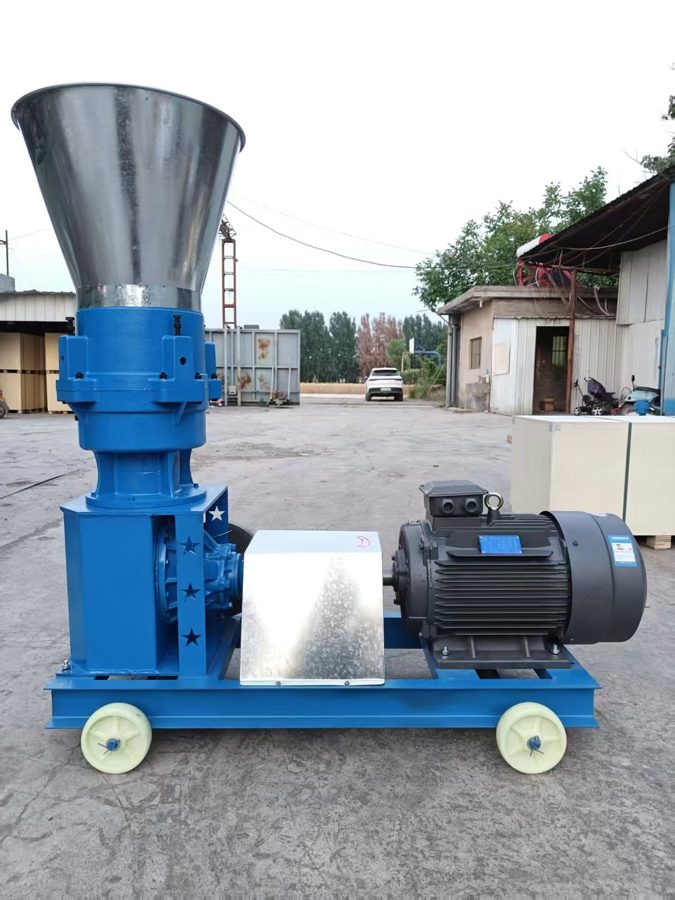
1. Size comes from ring die diameter and kW, not the model name
A pellet mill is defined by its ring die diameter and motor: 250 mm with 22 kW, 320 mm with 37 kW, 400 mm with 90 kW, and 508 mm with 160 kW. Ask for both numbers, because two factories can call very different machines 'the same model'.
2. Output is a range, and the low end is the honest end
A 320 mm, 37 kW mill runs 0.8 to 1.2 tonnes per hour on chicken feed and 0.5 to 0.7 tonnes per hour on high-fibre grass or straw. Plan your storage and labour on the low figure, not the high one.
3. The compression ratio decides whether your material pellets at all
Die holes are 2 to 8 mm wide with a length-to-diameter ratio from 1 to 8. Corn and soybean meal press well near a ratio of 1 to 6; high-fibre material needs a lower ratio and more conditioning, or it comes out as crumbs instead of pellets.
4. Moisture and material move output more than the motor does
Feed should enter the die at 12 to 15 percent moisture. At 18 percent it slips in the die and output falls by a third; below 10 percent it burns and the die wears fast. Test your own material, not the factory's sample.
5. Steam conditioning raises output but needs a boiler
A conditioner adding steam at 80 to 90 C can lift output 20 to 30 percent and improve pellet durability. It only pays if your volume supports a small boiler and someone to run it every shift.
6. Look at the whole line, not just the mill
The pellet mill is rarely the bottleneck. A 1 t/h mill needs a crusher, a mixer, a cooler and a bagger sized for at least 1.2 t/h, or the mill waits and the real line output drops toward 0.7 t/h.
What actually moves the pellet mill price
Two '1 t/h' mills can differ by 50 percent in price. The difference is the ring die diameter and kW behind the number, the gearbox, whether the die is alloy steel or carbon steel, and whether the mill has a feeder, a conditioner and automation. Ask for die diameter, kW, die material and compression ratio in writing before you compare quotations.
Frequently asked questions
What is the real output of a 400 mm, 90 kW pellet mill?
About 1.5 to 2.5 tonnes per hour on poultry or pig feed, and 1.0 to 1.5 tonnes per hour on high-fibre material, depending on moisture and die condition.
Why does the factory quote a higher tonnage than I get?
Factory tests use a brand-new die, dry corn and a trained operator. A die that has run 600 hours, wetter material or a new operator will each cut output by 20 to 40 percent.
How often do I replace the ring die?
A 400 mm die pressing 2 t/h wears out after roughly 600 to 900 hours of production. Keep one spare die at the site: a change takes an hour, waiting for shipping takes a month.
Can one machine make both pellets and mash?
Yes. Run the material through the crusher and mixer only for mash, and add the pellet mill and cooler for pellets. It is the same line with one more step.
Do I need a cooler?
Above 0.5 t/h, yes. Hot pellets straight from the die are soft and go mouldy in the bag. A counter-flow cooler also brings the moisture down for safe storage.
What power supply does a 508 mm mill need?
Roughly 160 to 200 kW for the mill alone, plus the crusher, mixer and cooler. Plan a 250 to 300 kVA supply or a matching generator set.