How to Choose Concrete Batching Plant Capacity (HZS25-HZS90)
- ✓Nominal output is not working output
- ✓Match the mixer to the batching machine
- ✓Work backwards from your peak daily pour
A contractor in South Sulawesi ordered an HZS50 because the price looked right. Two weeks into the job he was pouring 110 cubic metres a day and the plant could not keep up, so he added a second mixer and lost the saving twice over. The number on the model plate is not the number the plant gives you.
Every HZS plant is quoted at a nominal capacity in cubic metres per hour, and every plant runs at roughly 70 to 80 percent of it once you count the real cycle: batching, mixing, discharging and waiting for trucks. An HZS50 is quoted at 50 m3/h and gives you about 40 m3/h on a good, clean day.
This guide gives the working numbers for each size, shows which mixer and batching machine belong together, and then walks you back from your peak daily pour to the model you should actually buy.
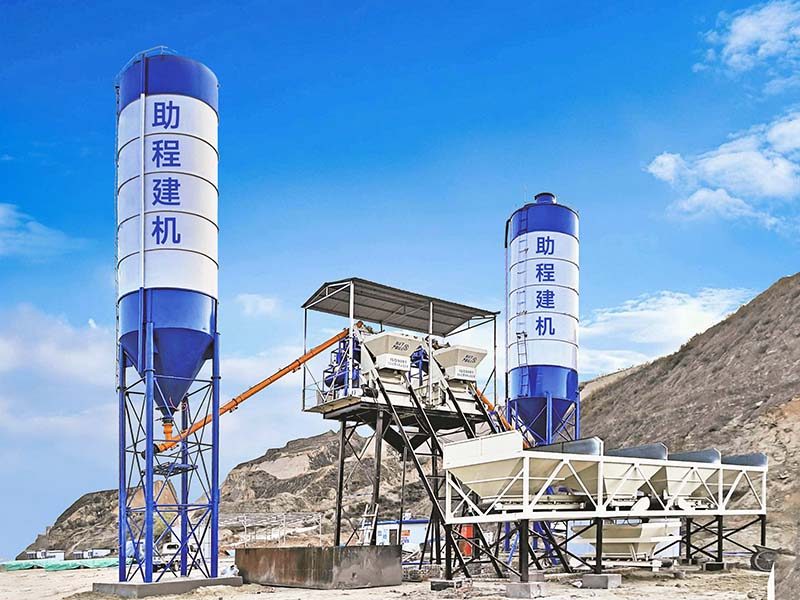
1. Nominal output is not working output
A plant quoted at 50 m3/h delivers about 40 m3/h with a clean cycle, and 32 to 35 m3/h once trucks arrive late or the aggregate is wet. Size the plant from working output, never from the model plate.
2. Match the mixer to the batching machine
HZS25 pairs a JS500 twin-shaft mixer with a PLD800 batcher, HZS50 a JS1000 with a PLD1200, HZS90 a JS1500 with a PLD2400. A big mixer behind a small batcher is a queue; a big batcher behind a small mixer is wasted money.
3. Work backwards from your peak daily pour
Take your busiest day's cubic metres, divide by the 8 to 10 productive hours, then add 30 percent for the real cycle derate. A 300 m3 peak day means 38 to 40 m3/h in practice, which is an HZS50, not an HZS35.
4. Check the cycle time and the truck count
A twin-shaft mixer discharges a batch in about 35 to 45 seconds, so an HZS50 turns close to 40 batches an hour at about 1 m3 per batch. If you must keep eight mixer trucks moving, the plant is the bottleneck, not the fleet.
5. Do not forget ground, power and silos
An HZS90 on a fixed foundation needs roughly 40 by 20 metres of hardstanding, 150 to 200 kW of connected load, and two or three 100-tonne cement silos. A mobile HZS25 on skids needs a quarter of that footprint and a far smaller transformer.
6. Buy a plant you can grow into
If your volume may double in two years, buy the frame and foundation for one size up and change only the mixer and batcher later. Replacing the whole plant body costs far more than ordering one size larger on day one.
The real rule for judging a batching plant price
Price is set by three things: the mixer size, the number of aggregate bins on the batching machine, and how automatic the control system is. Two quotes for an 'HZS50' can differ by 40 percent because one has a manual cabinet and a two-bin batcher and the other a PLC with a three-bin batcher and a printer. Ask for the exact mixer model, bin count and control type before you compare money.
Frequently asked questions
What is the real output of an HZS25?
About 18 to 20 m3/h working, or 140 to 160 m3 in an eight-hour day, with a JS500 mixer and a two-bin PLD800 batcher.
Can I run an HZS50 with a JS750 mixer?
No. An HZS50 is built around a JS1000. Fitting a JS750 makes it an HZS35 that costs like an HZS50 and wears out sooner.
How many cement silos do I need?
One 100-tonne silo covers a single-cement mix for a normal day. If you switch between two cement types, or a day's pour exceeds 300 m3, plan for two.
Mobile or fixed plant?
Mobile skid plants from HZS25 to HZS50 move with the job and need less foundation. Fixed plants above HZS75 cost less per cubic metre, but they do not travel.
Do I need a generator?
If the site has no reliable grid, budget 15 to 20 percent of the plant price for a matching generator set, and remember an HZS90 pulls 150 to 200 kW at full load.
How long does installation take?
A trained crew installs and commissions a fixed HZS50 in about 10 to 15 days including the foundation cure, and a mobile plant in 3 to 5 days.